

Key Update
January 7, 2026
By Joe Neighbour
See profile
All performance figures shown are simulated and do not reflect actual trading results. No real money was invested, and actual results may differ materially
December delivered a complex and fragmented trading environment across global markets, shaped by year-end positioning, shifting macro expectations, and pockets of thinning liquidity. While several asset classes respected well-defined technical structures, others were characterised by choppy, low-conviction price action. This report outlines how we navigated these conditions, highlighting the key macro drivers, asset class performance, and standout opportunities that defined the final month of the year.
Asset Class Summary
Forex
Into December, FX markets transitioned from November’s directional trends into a more tactical, policy-driven environment. The U.S. dollar entered the month on a softer footing as expectations around a December Fed rate cut became more firmly embedded, though downside momentum moderated amid year-end positioning and reduced liquidity. EUR/USD and GBP/USD remained supported but showed signs of consolidation, with gains increasingly dependent on confirmation from incoming inflation and growth data rather than yield differentials alone. USD/JPY shifted decisively lower after the Bank of Japan’s hawkish recalibration, reinforcing a structural turn in yen dynamics as markets reassessed the timing and pace of policy normalization. Commodity currencies continued to trade constructively, but December price action favoured selective, range-based strategies over aggressive trend extension as risk appetite became more episodic.
Equity Indices
Global equities entered December with positive but more fragile momentum. U.S. indices held near record territory, yet leadership narrowed meaningfully as investors rotated away from crowded mega-cap and AI exposures into defensives, financials, and value-oriented sectors. The Dow remained relatively resilient, reflecting late-cycle and year-end allocation preferences. European equities benefited from stable energy prices and improved earnings visibility in banks and industrials, though upside was capped by slowing growth expectations. Volatility remained compressed overall but prone to sharp, event-driven spikes around central bank messaging and key U.S. macro releases, favouring tactical exposure, mean-reversion, and selective sector rotation rather than momentum-chasing into year-end.
Commodities
Commodities traded with a supportive but restrained bias in December. Gold continued to benefit from softer real yields and lingering Fed easing expectations, though gains slowed as investors awaited clearer confirmation of policy follow-through. Oil prices stabilised further, supported by OPEC+’s commitment to output discipline and seasonal demand factors, but upside remained capped by global growth concerns. Industrial metals maintained modest strength, underpinned by incremental Chinese policy support and emerging supply-side constraints, though price action reflected cautious positioning rather than outright bullish conviction.
Cryptocurrencies
Crypto markets entered December still digesting November’s sharp deleveraging phase. While selling pressure eased, conditions remained fragile as liquidity stayed constrained and risk tolerance subdued. Bitcoin attempted to stabilise after its steep drawdown, but upside momentum struggled to re-establish itself amid persistent ETF outflows and cautious institutional flows. Ether and broader altcoins lagged, reflecting ongoing balance-sheet repair and selective risk reduction. Overall sentiment improved marginally from extreme bearishness but remained defensive, with December price action favouring consolidation and volatility-driven opportunities rather than sustained trend recovery.
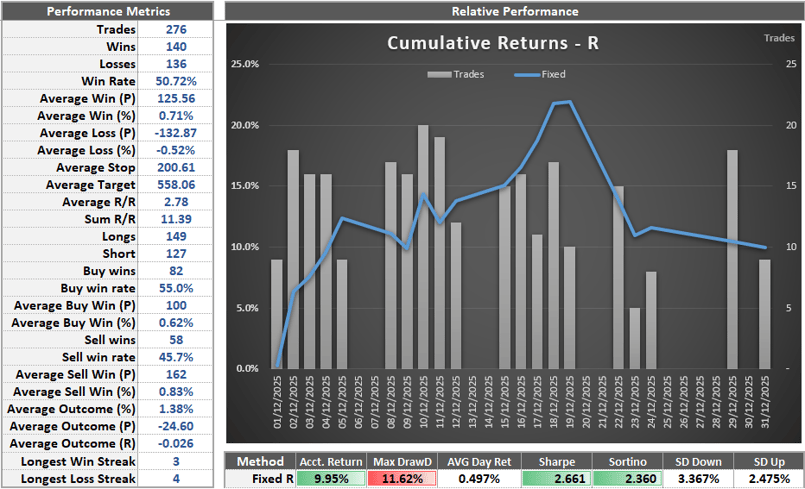
The simulated performance statistics provided are based on the assumption of risking 1% of trading capital per trade. It is crucial to understand that past performance, whether actual or simulated, is not indicative of future results.
12 month simulated performance statistics
| Jan 25 | Feb 25 | Mar 25 | Apr 25 | May 25 | June 25 | July 25 | August 25 | Sept 25 | Oct 25 | Nov 25 | Dec 25 |
| 12.66% | 16.50% | -7.53% | -19.13% | 19.22% | 34.08% | -20.56% | -8.70% | 0.69% | -1.48% | -2.61% | 9.95% |
Asset Class Performance
Performance dynamics shifted meaningfully during the month, with Commodities and FX Crosses emerging as the strongest contributors, while FX Majors, Indices, and Cryptocurrencies weighed on overall results to varying degrees. Returns dispersion across asset classes remained pronounced, reinforcing the importance of allocation balance and drawdown control.
Commodities were the clear standout, delivering an 11.22% return across 50 trades. A robust 58.00% win rate — the highest of all segments — combined with a contained -4.87% drawdown reflected favourable trade selection and strong follow-through during periods of elevated but directional volatility. This segment provided the bulk of positive performance for the month.
FX Crosses also finished firmly positive, returning 5.48% from 64 trades. A 48.44% win rate was sufficient to generate solid gains, supported by the shallowest drawdown across asset classes at -3.07%, highlighting improved structure and more consistent momentum relative to prior months.
Elsewhere, results were more mixed. FX Majors recorded a -6.01% return across 50 trades, despite a comparable 48.00% win rate. A deeper -11.12% drawdown pointed to less favourable risk–reward dynamics and reduced trend persistence, with losses outweighing gains during failed directional extensions.
Indices were broadly flat to slightly negative, finishing down -0.98% over 86 trades. A balanced 50.00% win rate masked a less constructive trading environment, as a -7.80% drawdown reflected choppy price action, false breakouts, and limited sustained momentum.
Cryptocurrencies also detracted modestly, posting a -1.69% return from 26 trades. A 50.00% win rate and relatively contained -3.00% drawdown suggested controlled risk exposure, but upside opportunities remained limited amid subdued liquidity and hesitant market participation.
Summary
In aggregate, Commodities and FX Crosses were the primary sources of strength, while FX Majors represented the largest drag on performance. Indices and Cryptocurrencies contributed marginally negative results but with manageable risk. The month highlighted the benefits of diversification across asset classes and underscored the need for adaptability as leadership rotated and market structure varied significantly between segments.
| Asset Class | Trades | Win Rate | Returns | Drawdown |
| FX Majors | 50 | 48.00% | -6.01% | -11.12% |
| FX Crosses | 64 | 48.44% | 5.48% | -3.07% |
| Commodities | 50 | 58.00% | 11.22% | -4.87% |
| Indices | 86 | 50.00% | -0.98% | -7.80% |
| Cryptocurrencies | 26 | 50.00% | -1.69% | -3.00% |
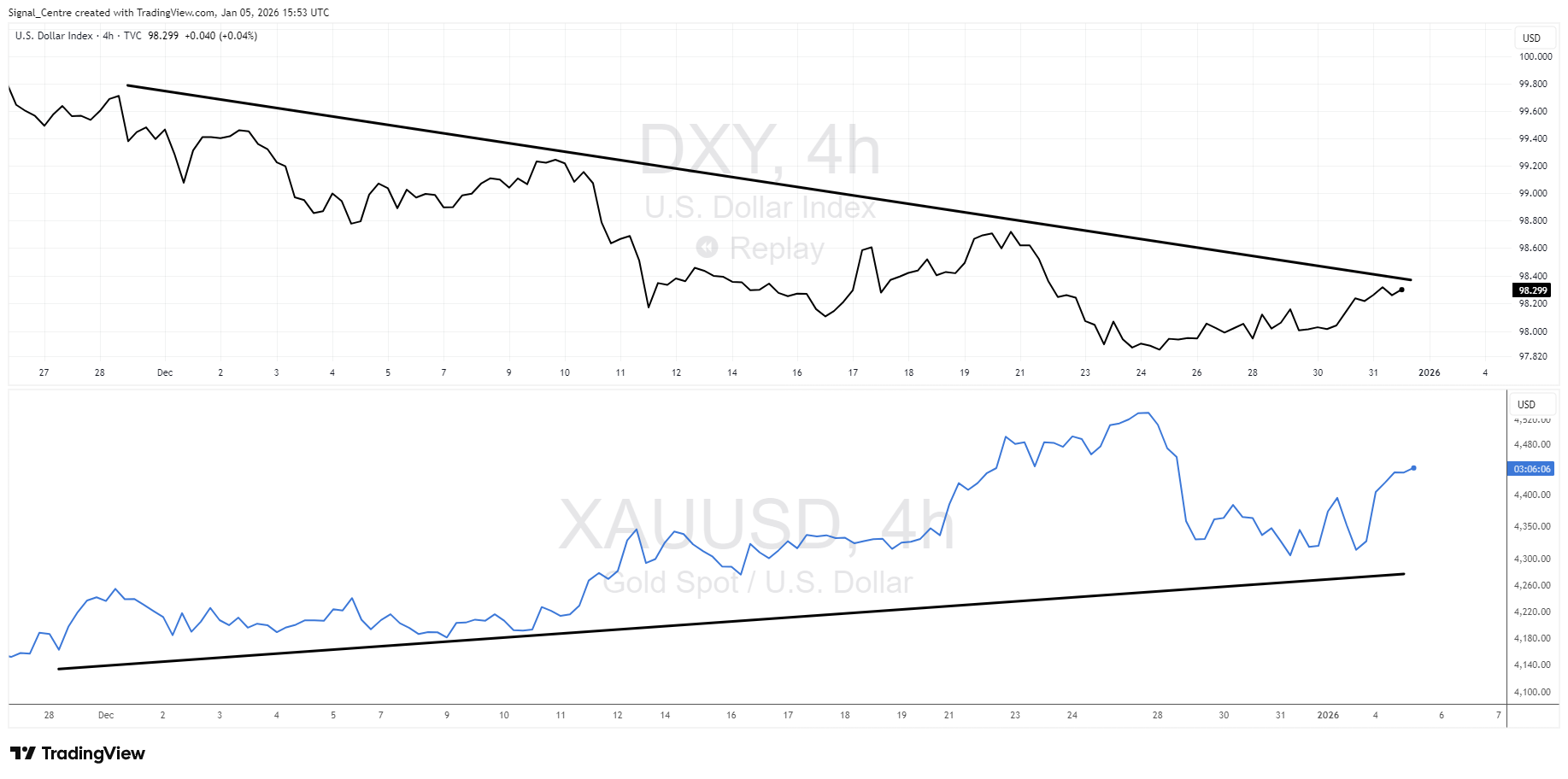
The black line highlights the DXY, which saw generally weak performance reflected across the FX majors. Although the broader December trend remained lower, mid-month price action showed some technical characteristics consistent with a potential short-term double bottom. This prompted our analysts to explore speculative counter-trend opportunities; however, these setups ultimately failed to gain traction, reinforcing the dominant bearish dollar bias.
The blue chart represents Gold, which continued to attract strong demand and pushed higher into year-end. The broader commodities space largely respected its underlying trends, delivering notable performance throughout the month. Strength was also evident in Silver, while Oil extended its bearish trend, contributing to strong and consistent gains across commodities overall.
Best/Worst Performing Markets
For the current month, performance was led by CAC, which delivered a 5.42% return across 14 trades, evenly split between long and short positions. A strong 64.00% win rate combined with a shallow -1.26% drawdown reflected balanced participation and effective risk control, allowing the strategy to capture gains despite alternating directional regimes in European equities.
EURSEK followed as the second-best performer, posting a 5.03% return from 7 trades. The positioning was predominantly short (6 shorts, 1 long), and a high 71.00% win rate alongside a contained -0.98% drawdown highlighted clean execution and favourable trend persistence in the cross, particularly during periods of euro softness relative to Scandinavian currencies.
Brent Oil rounded out the top contributors with a 4.34% gain over 9 trades. A notably high 78.00% win rate — the strongest among the top performers — and a minimal -0.75% drawdown underscored disciplined trade selection and effective navigation of volatile but well-defined price action in energy markets.
| Best | Trades | Long | Short | Win Rate | Returns | Drawdown |
| CAC | 14 | 7 | 7 | 64.00% | 5.42% | -1.26% |
| EURSEK | 7 | 1 | 6 | 71.00% | 5.03% | -0.98% |
| Brent Oil | 9 | 4 | 5 | 78.00% | 4.34% | -0.75% |
For the month, the weakest performance came from USDJPY, which recorded a -4.77% return across 11 trades, split between 6 long and 5 short positions. A low 27.00% win rate combined with a -4.81% drawdown highlighted difficult trading conditions, as unstable directional signals and abrupt reversals undermined trend persistence in the pair.
DAX followed as the second-largest detractor, declining -3.81% over 5 trades. Positioning was predominantly short (4 shorts, 1 long), but a 20.00% win rate and a -4.00% drawdown reflected choppy, low-conviction price action, making it challenging to sustain profitable exposure despite multiple attempts to engage downside momentum.
USDMXN rounded out the underperformers, posting a -3.27% return across 8 trades (5 long, 3 short). A 25.00% win rate and a -3.93% drawdown pointed to erratic volatility and shifting risk sentiment, which disrupted otherwise well-defined setups and limited follow-through.
| Worst | Trades | Long | Short | Win Rate | Returns | Drawdown |
| USDJPY | 11 | 6 | 5 | 27.00% | -4.77% | -4.81% |
| DAX | 5 | 1 | 4 | 20.00% | -3.81% | -4.00% |
| USDMXN | 8 | 5 | 3 | 25.00% | -3.27% | -3.93% |
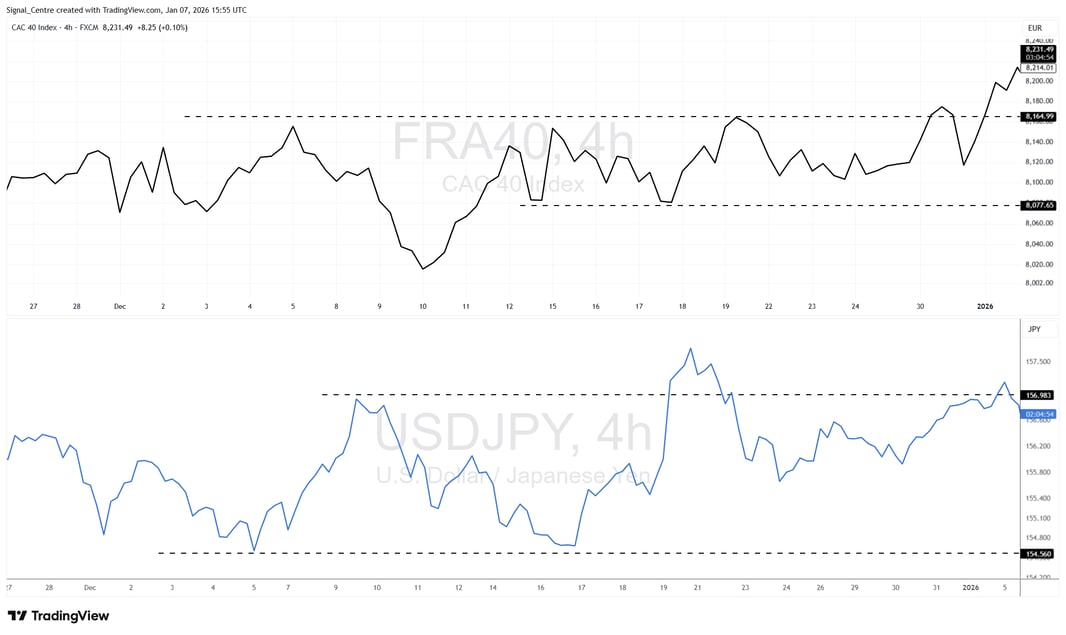
The black line represents the CAC 40, which proved to be our strongest performer of the month. As the year drew to a close, equity indices were largely rangebound, and the CAC 40 was no exception. Price repeatedly tested strong resistance near 8165, while finding reliable support around 8077 mid-month. These well-defined, two-way conditions created a highly tradable environment, allowing our analysts to capitalise on both long and short opportunities. In total, we executed 14 trades (7 long and 7 short), achieving a 64% win rate.
The blue chart refers to USDJPY, which also traded in a rangebound manner but delivered less favourable results. A mid-month break of resistance aligned with the potential double-bottom formation observed in the dollar index; however, the move failed to generate sustained upside momentum. We traded in both directions, placing 6 long and 5 short trades, but poor follow-through and suboptimal timing led to a reduced 27% win rate, making USDJPY a more challenging instrument to navigate during the period.
Major Macroeconomic Data
Here is a snapshot of how our trade ideas performed on the day of key macroeconomic data.
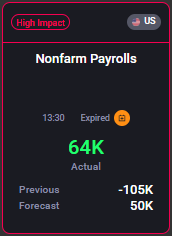
US Nonfarm Payrolls - 16th November 2025
| Event | Date | Trades Triggered | Win Rate | Return |
| US Nonfarm Payrolls | 16/12/2025 | 17 | 58.82% | 1.79% |
December’s U.S. Non-Farm Payrolls release delivered a solid upside surprise, with employment rising by +64k versus a 50k consensus forecast. The initial market reaction saw a brief pullback in the dollar index (DXY); however, this move quickly reversed, with the DXY rallying nearly 0.80% over the subsequent 24 hours as participants reassessed the broader macro implications. The stronger print helped stabilise expectations around U.S. growth, even as rate-cut pricing remained an underlying theme in markets.
Against this backdrop, the strongest trading results came from our short position in Oil (+2.03%), as downside momentum accelerated cleanly. Additional solid gains were generated from the NZDJPY long (+1.37%), the CAC40 long (+0.975%), and the EURAUD long (+0.764%), each benefiting from well-defined technical structures and sustained follow-through. On the downside, we experienced stop-outs in GBPYJPY, EURSEK, USDJPY, and EURGBP, largely reflecting choppy price action and abrupt intraday reversals that challenged directional conviction. Overall, December trading conditions rewarded selective positioning, while underscoring the importance of disciplined risk management in a volatile year-end environment.
Trade of the Month - Ethereum - 10th December 2025
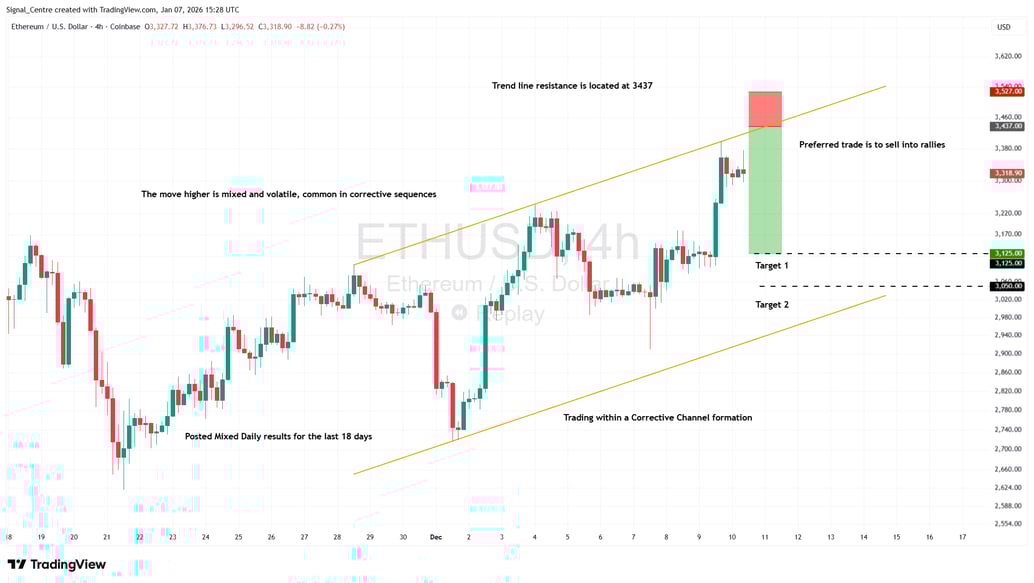
The Trade of the Month focused on Ethereum, where we sold into strength during a volatile and corrective market environment. Price action over the prior sessions was mixed and choppy, characteristic of a corrective sequence rather than a sustainable trend. Ethereum remained confined within a corrective channel, with 3437 acting as clear trendline resistance. Given repeated failures at this level, selling rallies remained the preferred strategy.
With broader crypto markets still digesting November’s deleveraging and risk appetite subdued, Ethereum continued to lag. As price rallied into resistance, we initiated a short position at 3437, with a stop at 3527 and downside targets at 3125 and 3050, offering a 1 : 3.47 risk-to-reward. The subsequent rejection from resistance validated the setup, highlighting the importance of disciplined structure analysis and precise execution in corrective market conditions.
- Direction: Sell
- Entry Level: 3437
- Stop: 3527
- Target 1: 3125
- Target 2: 3050
- Risk/Reward: 1 : 3.47
The setup
-
Posted Mixed Daily results for the last 18 days
-
The move higher is mixed and volatile, common in corrective sequences
-
Trading within a Corrective Channel formation
-
Trend line resistance is located at 3437
-
Preferred trade is to sell into rallies
Here's a graphical depiction illustrating the trade setup and the analytical process behind Ethereum.
The Outcome
The trade was triggered precisely at our predefined entry level at 20:10, following a brief probe into resistance. Price then reversed sharply from the identified zone, with bearish momentum maintained throughout the session. Drawdown was limited to just 40 pips, underscoring accurate level selection and strong structural alignment. The first profit target was only reached after the 12:00 expiry the following day at 15:00, before price continued to move lower and hit our second target at 3050 at 16:00 on 11 December. At the time of expiry, price was trading at 3193.6, equating to a return of 2.63R.
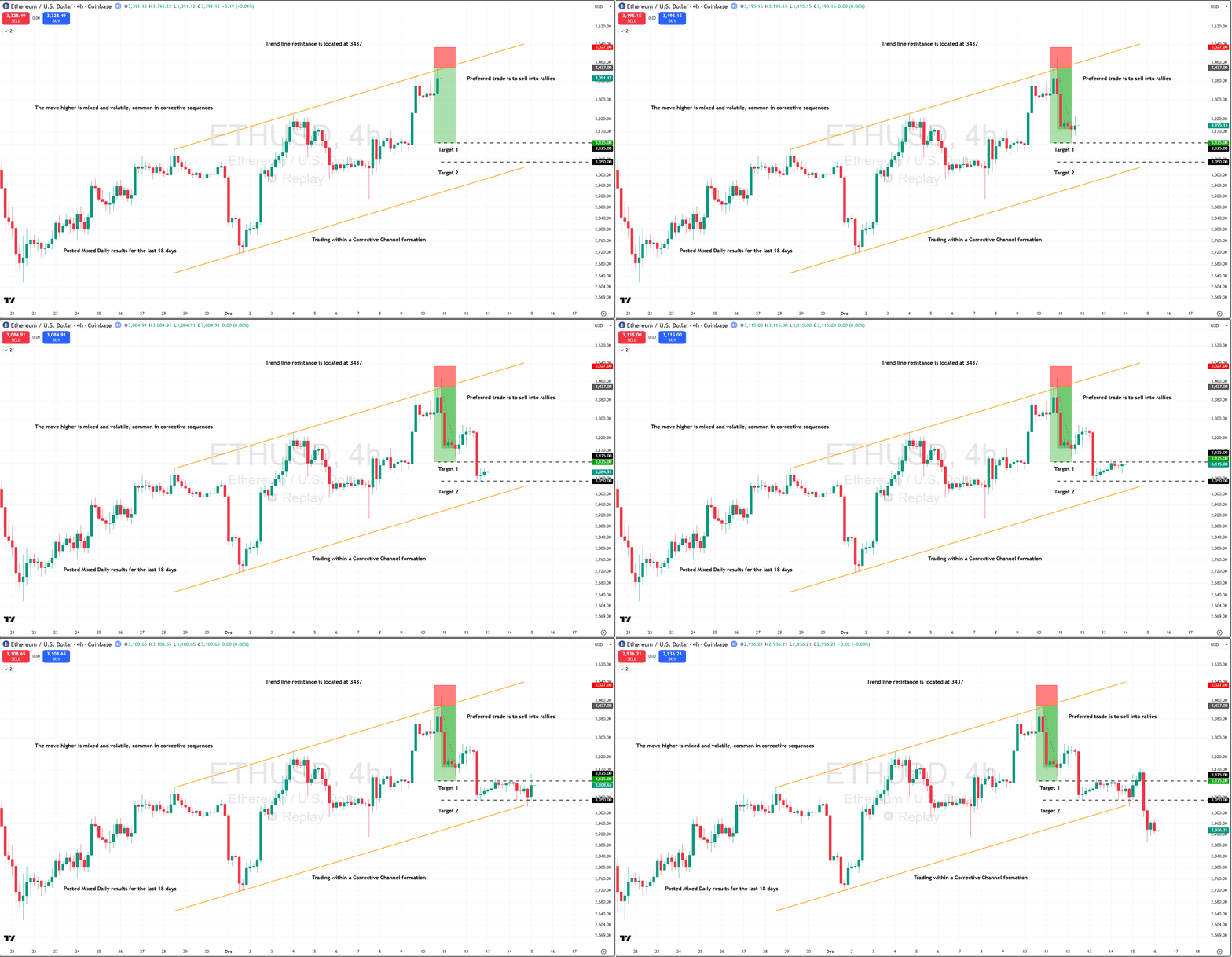
Published: 12:54 UK (10th December 2025)
Triggered at: 20:10 UK (10th December 2025)
Exit at: 12:00 UK - (10th December 2025) - Trade Expired
Duration: 15 Hours and 50 minutes
Outcome: 2.63R
Overall performance reflected a market in consolidation rather than trend expansion. Commodities and FX Crosses emerged as the strongest contributors, benefiting from clearer structure and more consistent follow-through, while FX Majors, Indices, and Cryptocurrencies proved more challenging amid range-bound behaviour and subdued risk appetite. Risk was effectively managed despite uneven conditions, reinforcing the importance of diversification, tactical flexibility, and disciplined execution as markets transitioned into year-end.
Thank you for your continued trust in Acuity Trading. Stay tuned for more updates and insights in the coming months.
Acuity Research is authorised and regulated by the Financial Conduct Authority (FCA), firm reference number 787261
Risk Warning
The simulated performance statistics provided are based on the assumption of risking 1% of trading capital per trade. It is crucial to understand that past performance, whether actual or simulated, is not indicative of future results. Trading involves substantial risk and is not suitable for every investor. The figures presented are hypothetical and do not account for real market conditions, such as liquidity, slippage, or transaction costs. You should be aware of the risks involved and be prepared to potentially lose your entire investment. Always seek independent financial advice before making trading decisions.
More news
Signal Performance Review - January 2026
All performance figures shown are simulated and do not reflect actual trading results. No real money was invested, and actual results may differ...